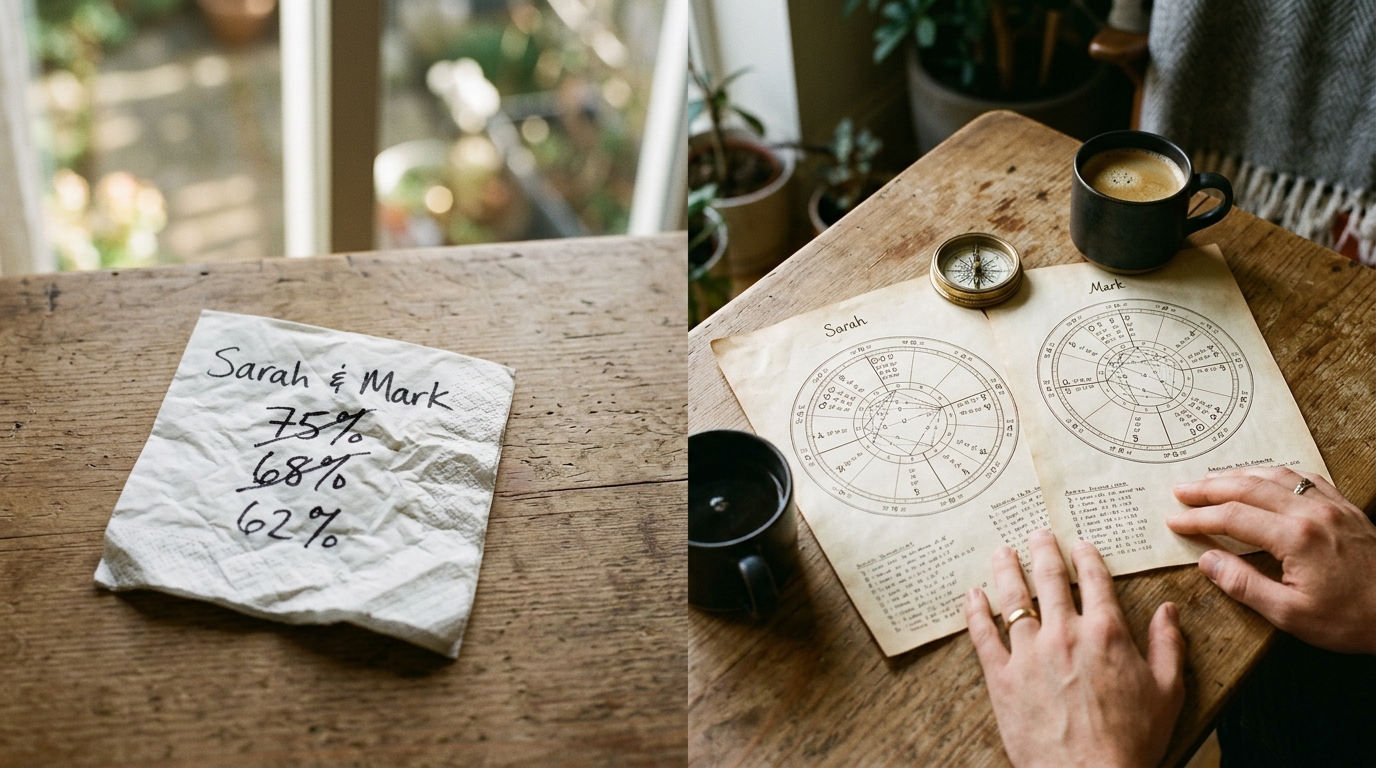
You typed two names into one calculator and got 87%. A second one said 54%. A third called you "soulmates" and then asked for your email. None of them was lying, exactly. They were answering three different questions with three different sets of ingredients, and none of them told you what those ingredients were.
That is the real problem with compatibility scores. The number matters far less than what went into it. A result built from the letters in your names knows nothing about you. A result built from two full birth charts knows a great deal, but it needs inputs most people don't have on hand.
So this article ranks the methods you've probably already tried, from FLAMES to synastry, by one standard: how much each one actually knows about the two of you. Then I'll tell you which fits your situation, whether you're dating, engaged, family-introduced, or stuck in "it's complicated." Think of it as an ingredient label for every score you've been handed.
Why do three love calculators give you three different numbers?
Because they aren't measuring the same thing. "Compatibility" is a word, not a unit. Each tool picks an input, runs a formula, and prints a percentage. Change the input and you change the answer, even though the output always looks equally official.
There are really only four kinds of input in circulation:
- Your names. Letters, counted or compared.
- Your birth dates, reduced to numbers. Numerology.
- Your birth dates, read as sky positions. Sun sign, element, modality, and sometimes Moon, Venus and Mars.
- Your birth date, time and place. Full charts, used in synastry and kundli matching.
Each step down that list gives the method more to work with. Tools in the same category will often agree with each other, and tools from different categories will often clash. If your three numbers contradicted each other, the likeliest explanation is that you quietly used three categories.
The other reason numbers disagree is scale. One tool might score out of 100, another out of 36, and a third might not score at all, just hand you a label like "Friends." A 54% from a formula that rarely goes below 40 is a different statement from a 54% from one that spreads results evenly from 0 to 100. Without the method, you can't tell which you're looking at.
Your names are a hash, not a personality
A hash is a procedure that turns any input into a fixed-looking output, with no meaning attached to the result. Many name-based meters work this way. They assign values to letters, add them up, and divide or reduce until a percentage falls out. I'm describing a type here rather than any single tool, because the details vary, but the logic is the same: the output is a function of spelling.
The test is easy to run yourself. Take your name and add a middle initial, or switch "Kate" to "Katherine." The score moves. Your personality didn't. Your partner's attachment style, how they handle money, whether they want children: none of it entered the formula, and none of it could.
That doesn't make name meters worthless as entertainment. It makes them worthless as information. If a result changes when your spelling changes, it was never describing you.
What does each compatibility method actually look at?
Here are the five methods in order of how much they know, with the exact input each one uses. I'm presenting this ranking as my own standard, based on one question: how much of each person does the method's input contain?
FLAMES and name games: letters only
FLAMES is a playground classic, and it's worth knowing how it works. You write both names, cross out letters that appear in both, count the letters left over, and use that count to eliminate letters from the word F-L-A-M-E-S (Friends, Love, Affection, Marriage, Enemies, Siblings) in a circle until one remains.
Inputs: two names. That's all. It knows nothing about birth, temperament, or behavior. The "result" is arithmetic on spelling, which is why two people can get "Enemies" from one spelling and "Marriage" from another. I've got a longer take on why you can ignore a bad result and still enjoy playing in FLAMES Said "Enemies." Here's Why You Should Ignore It (and Why We Still Play).
Depth: lowest on the list. Best use: a group chat at 1 a.m.
Numerology: birth date reduced to one digit
Numerology moves up a rung because it uses something real about each person: when they were born. The most common version calculates a life path number by adding the digits of a birth date until a single digit remains. For someone born 2 June 1993: 2 + 6 + 1 + 9 + 9 + 3 = 30, then 3 + 0 = 3. Their life path is 3. Some systems reduce day, month and year separately first, and some keep "master numbers" like 11 and 22 unreduced, so even numerologists don't fully agree on the arithmetic.
Compatibility is then read by comparing the two numbers, for example how a 3 relates to a 7. Be clear on what kind of claim this is: the meanings attached to each number are conventional and symbolic. There's no physical mechanism linking digit sums to behavior. What numerology does give you is a consistent vocabulary, and a consistent vocabulary can prompt useful conversation.
Inputs: birth day, month, year. Limits: it compresses everything into nine or so categories, so millions of people share your number. For a closer look, see Your Life Path Number Has Opinions About Your Relationship. Some Are Even Right.
Sun-sign compatibility: element plus modality
This is the method most people mean when they say "he's a Scorpio." Your sun sign comes from your birth date alone, and each sign carries two labels you can check yourself:
- Element: Fire (Aries, Leo, Sagittarius), Earth (Taurus, Virgo, Capricorn), Air (Gemini, Libra, Aquarius), Water (Cancer, Scorpio, Pisces).
- Modality: Cardinal (Aries, Cancer, Libra, Capricorn) start things. Fixed (Taurus, Leo, Scorpio, Aquarius) hold things. Mutable (Gemini, Virgo, Sagittarius, Pisces) adapt to things.
The scoring logic is traditional rather than experimental. Fire and Air are considered to feed each other, and so are Earth and Water. Fire with Water or Earth with Air are the classic friction pairings. Same-element pairs tend to understand each other's temperament quickly.
What signs are most compatible together? By this convention, the pairings usually listed as easiest are the same-element-family matches: Aries–Gemini, Leo–Libra, Sagittarius–Aquarius (Fire and Air), and Taurus–Cancer, Virgo–Scorpio, Capricorn–Pisces (Earth and Water). That's a general tendency of the system, not a promise about any individual couple.
Modality adds the second layer, and this is where the real clashes hide:
- Cardinal + Cardinal (say, Aries and Capricorn): both want to lead, so the friction is over who decides.
- Fixed + Fixed (say, Taurus and Scorpio): both dig in, so arguments can last a very long time.
- Mutable + Mutable (say, Gemini and Pisces): both adapt, so decisions can drift without anyone making them.
Inputs: one birth date each. Limits: it reads one planet, the Sun, which is roughly your public temperament. It says little about how you love, fight, or communicate under stress. That's a Moon and Venus question.
Synastry: two full birth charts overlaid
Synastry is the astrologer's method. You cast each person's natal chart, which needs birth date, exact time, and birthplace, then lay one over the other and read the angles (aspects) between planets. Where one person's Venus sits against the other's Mars, or one person's Moon against the other's Saturn, tells you how the two charts interact. House overlays show which area of life a partner's planets fall into for you.
This is the only mainstream Western method that handles life areas separately by design: Venus and Mars contacts for attraction and chemistry, Moon contacts for emotional safety, Mercury contacts for communication, Saturn contacts for commitment and friction. Interpretation is a craft, and astrologers can read the same overlay differently. That is what makes it richest and also least standardized. If you want to see it applied, Synastry Charts Explained Through the Fights You're Already Having walks through a synastry chart using ordinary arguments.
Inputs: two birth dates, two birth times, two birthplaces. Limits: if either time is wrong, the Ascendant and houses go with it.
Kundli matching: 36 gunas and a marriage threshold
Kundli matching, or Guna Milan, comes from the Vedic tradition and is the only method here with a formal scorecard. It uses each person's Moon sign and nakshatra (the Moon's position among 27 lunar mansions) and scores eight categories (kutas) that add up to 36 points:
| Kuta | Points |
|---|---|
| Varna | 1 |
| Vashya | 2 |
| Tara | 3 |
| Yoni | 4 |
| Graha Maitri | 5 |
| Gana | 6 |
| Bhakoot | 7 |
| Nadi | 8 |
A score of 18 or more is the commonly cited threshold for proceeding with a match, though families and astrologers apply it with varying strictness. Many also check separate factors such as Manglik status alongside the points. The Moon moves signs about every two and a quarter days, so a birth date is often enough to find it, but anyone born on a day when the Moon changed sign needs the birth time.
It knows a great deal, but it was designed for one question: is this a workable marriage? It isn't built for "are we infatuated?" For the full comparison against Western charts, see Kundli Matching vs. Western Compatibility: What 36 Gunas See That Your Zodiac Sign Doesn't.
Comparison table: inputs, depth, and what each method misses
Here is the whole ranking in one place. "Depth" is my rating of how much of each person the inputs can contain. It is not a rating of how accurate the method is at predicting outcomes, because none of them has shown it can predict whether a relationship will last.
| Method | Exact inputs | Depth (1 = least, 5 = most) | What it misses |
|---|---|---|---|
| Name hash / name meter | Two names (letters) | 1 | Everything about the people; the score shifts with spelling |
| FLAMES | Two names, shared letters crossed out | 1 | Everything about the people; six possible outcomes only |
| Numerology | Birth day, month, year reduced to a digit | 2 | Individual variation (a huge share of people share your number); no mechanism |
| Sun-sign (element + modality) | One birth date each | 3 | Moon, Venus, Mars; how you love and fight beneath public temperament |
| Birth-date reading (Sun, Moon, Venus, Mars from date) | One birth date each | 3.5 | Houses, Ascendant, exact aspects that need birth time |
| Synastry | Date, time and place for both people | 5 | Needs accurate times; interpretation varies by astrologer |
| Kundli matching | Moon sign and nakshatra, from date (and time, when the Moon changes sign that day) | 4.5 | Built for a marriage decision; weaker on day-to-day chemistry and communication |
Notice what the table shows. Depth rises with the amount of birth information, not with the sophistication of the formula. A simple formula on a full chart outranks a complicated formula on two names.
The one skepticism paragraph
A reasonable reader asks whether any of this is real. Here is my plain answer. There is no demonstrated physical mechanism by which planetary positions shape personality or relationship outcomes, and I won't pretend otherwise. What I can say is narrower: astrology is a structured vocabulary for talking about temperament, timing, and friction, and the ranking above measures how much structure each method brings. Treat the output as a set of questions to ask each other, not a ruling. That applies to every method on this page, including the traditional ones.
What attraction science adds that astrology doesn't
Astrology maps temperament. It doesn't map what's happening in your body when someone walks into a room, and it can't see the daily behaviors that decide whether a relationship holds. Attraction research can see some of that, and it's worth borrowing from.
Writers like Louann Brizendine, a neuropsychiatrist known for popular books on the brain, have brought the psychology of attraction to general readers. The general idea in that literature is that early romantic attraction involves hormones and brain chemistry that make a new person feel intensely significant, and that this state is partly separate from whether two people will live well together. I'm keeping this at the level of the general idea rather than citing particular findings, because popular summaries of this research are often stronger than the evidence beneath them.
That distinction answers two of the questions readers send me most.
Can two people be in love but not be compatible? Yes, and this is the clearest thing attraction science adds. Falling in love is a feeling that happens to you. Compatibility is a pattern in how two people behave over time. You can be intensely attracted to someone who wants a different city, a different financial life, or a different number of children. Astrology can show where two temperaments rub, such as a Cardinal–Cardinal pair fighting over who decides, but it can't tell you that you've been avoiding the money conversation.
How can you tell if someone is compatible with you? Check things you can observe, not feel:
- How you handle disagreement. Do you repair after a fight, or does it stay open for days?
- Shared practical values. Money, children, where to live, how to treat family.
- Consistency. Do their actions in month six match their words in month one?
- Whether you feel more or less like yourself around them.
None of these needs a chart, and a strong score never substitutes for them.
People already sense this. One 28-year-old woman on Reddit, looking to date seriously for marriage, asked how to realistically determine true compatibility, which is the question behind most calculator searches. People type names into calculators because they want a shortcut for something that is really learned through time and behavior.
So here is how I'd divide the labor. Astrology and numerology are useful for temperament and for giving you language for patterns. Attraction science is useful for understanding why the early weeks feel so certain. Observation over time is the only thing that tells you whether it works. The best use of any method on this page is to tell you where to look, not to tell you what you'll find.
Which method fits where you are: dating, engaged, arranged, or it's complicated
The right method depends less on how serious you are than on what information you actually have and what decision is in front of you.
Dating someone new
You probably have a birthday and maybe a birthplace, but not a birth time, and you likely don't want to ask for one on date three. Use a birth-date reading: Sun, Moon, Venus and Mars signs, all of which can be worked out from a date. It will tell you where you'll likely agree (shared elements) and where you'll clash (modality). Skip name games for anything beyond fun. This stage is mostly infatuation chemistry, and a reading that separates love from communication from chemistry will do more for you than one percentage.
Engaged
At this point the stakes justify depth. If you can get birth times, a synastry reading is worth it, because it handles commitment, money, and communication separately instead of blending them. Look especially at Saturn contacts (how you carry responsibility together) and Moon contacts (emotional safety). Treat any weak area as something to plan around, not a warning. Pairings with a strong chemistry area but a thin communication area are common and workable if both people know it.
Arranged or family-introduced
Here kundli matching is the right tool, because it's the shared language families already use, and it was built for exactly this decision. Get the Guna Milan score, note whether it clears the usual 18-point threshold, and check Manglik status if your family does. But remember the limit: the 36 points tell you about traditional marriage fit, not whether the two of you enjoy each other's company. Use a Western-style reading of communication and friendship alongside it, then spend real time talking. Compatibility on paper is a starting point when you're meeting a stranger.
It's complicated
This is the situation where numbers do the most harm, since you're looking for a verdict on something undefined. The most useful thing is a method that separates areas, so you can see whether the pull is chemistry (Venus–Mars) while communication (Mercury) or commitment (Saturn) is the weak link. That often explains "we can't stay away from each other, and we can't talk about what we are." A single percentage can't show you that. A synastry-style breakdown can, and a birth-date reading gets you part of the way.
One more link that belongs here: if you've been counting days together as a sign of something, The Love Calculator Days Trend: What Counting Days Together Can and Can't Predict covers what that does and doesn't tell you.
Where to start if you only know their birthday
A birthday is more than most people think. From the date alone, you can find these with no time or place:
- Sun sign: their public temperament, and their element and modality.
- Moon sign: usually. It changes about every two and a quarter days, so it's reliable unless the date falls on a changeover day.
- Venus sign: how they show and want affection. Venus stays in a sign for weeks, so the date is enough.
- Mars sign: how they pursue, argue, and handle anger. Also weeks per sign.
- Mercury sign: how they talk and think.
You can't get the Ascendant or houses without a birth time, and that is where full synastry gets its precision. But the five placements above cover most of what couples actually ask about, and they split cleanly across life areas.
Here's a concrete next step you can do in about ten minutes:
- Write down both Sun signs and note each one's element and modality. Check for the friction pairings: same modality is the one to watch, as in two Fixed signs or two Cardinal signs.
- Look up both Moon signs. A Fire Moon with a Water Moon is a classic emotional mismatch in pace: one reacts fast, one processes slowly. That is a general tendency, not a rule for every pair.
- Compare Venus signs for how each of you gives and wants affection. If one person's Venus is in Taurus (physical, steady) and the other's is in Gemini (verbal, variable), you've found a likely gap before it becomes an argument. For a plainer take on this, see He's a Taurus Who Gives Gifts. You're a Gemini Who Needs Words. Now What?
- Compare Mars signs for how you each fight.
- Pick one gap and raise it in conversation, as curiosity rather than as a verdict. That conversation is worth more than any score.
When you've done the by-hand version and want your actual pairing laid out, you can read your compatibility from both birth dates and see how it breaks down across love, chemistry, marriage, communication and friendship. That gives you the area-by-area view this whole article has been arguing for.
And if some of the readings contradict what you know about your partner, believe what you know. These methods are prompts, and the person in front of you is the data. Use the ranking to decide how much weight any single number deserves, which, for anything built on names alone, is none.