What does a kundli matching score actually measure?
You have the biodata swapped, the families have been on the phone, and someone's aunt has produced a number out of 36. Before you treat it as a verdict, it helps to know what is being added up.
A word on skepticism, once: nobody has shown that stars cause marital outcomes, and I won't pretend otherwise. Kundli matching is a traditional framework for comparing two people, and so is Western sign reading. Use both as lenses for conversation, not predictions.
The score comes from two birth details: the Moon's sign (rashi) and its nakshatra, one of 27 lunar mansions. Each of the eight kootas compares your Moon placements on a different theme and awards points.
The eight kootas and their points
| Koota | Max points | What it represents |
|---|---|---|
| Varna | 1 | Temperament and ego compatibility, traditionally framed as spiritual outlook |
| Vashya | 2 | Mutual influence: who sways whom |
| Tara | 3 | Health and well-being, from nakshatra counts |
| Yoni | 4 | Physical and sexual chemistry |
| Graha Maitri | 5 | Mental friendship, based on the Moon-sign rulers |
| Gana | 6 | Basic nature: divine (deva), human (manushya) or fierce (rakshasa) |
| Bhakoot | 7 | Emotional bond, family welfare and money |
| Nadi | 8 | Health and genetic compatibility; traditionally the heaviest check |
That adds up to 36. Notice the weighting: Nadi, Bhakoot and Gana carry 21 points between them, so a score can swing on temperament and family-wellbeing themes while the "friendship" koota is worth only 5. Reading the breakdown is far more useful than reading the total.
Is 18 out of 36 really the cutoff?
Yes, by convention. Eighteen, exactly half, is the traditional minimum for going ahead. It is a customary threshold, not a law of nature, and different priests and families apply it with different strictness.
What is a good kundli matching score? The commonly used bands, which vary by family and pandit:
- Below 18: not recommended in the traditional reading
- 18-24: acceptable
- 25-32: good
- 33-36: excellent
A perfect 36 is uncommon, and I'd be wary of anyone who treats it as a promise.
What to do if the gunas don't match. First, look at which kootas lost points, because a 17 made of small misses is very different from a 17 where Nadi is zero.
- Nadi at 0 (Nadi dosha): same Nadi is the one most families take seriously, since this koota is tied to health and children in the tradition. Many pandits cite exceptions, such as differing nakshatras within the same Nadi. Others hold firm. Ask your family's priest which school they follow.
- Bhakoot at 0: this points to friction around emotional rhythm and shared finances. The couple needs explicit money conversations early: who manages what, and what support goes to parents.
- Gana at 0: a clash of basic temperament, such as a deva with a rakshasa. It tends to need patience around conflict style, not a breakup.
- Low Graha Maitri: you may not naturally think alike, so you need deliberate communication habits.
Beyond that, it depends on the two people. Several pandits will also check the full birth charts, which can offset a weak koota. Get a second pandit's view if the first one is blunt and you're unsure.
What about Manglik dosha?
Manglik dosha is a separate check from the 36 points. It looks at where Mars sits in each person's birth chart. If Mars is in the 1st, 4th, 7th, 8th or 12th house (some traditions add the 2nd), the person is called Manglik. The tradition links Mars with intensity, anger and friction, and the 7th house with marriage.
How families treat it varies widely:
- Both Manglik: traditionally seen as cancelling out, so many families relax.
- One Manglik, one not: this is where worry arises. Some families request remedies, such as a ritual before the wedding, or reconsider the match.
- Partial or "mild" Manglik: pandits often argue that Mars's sign, aspects from other planets or the person's age reduce the effect. Whether it counts is interpretive and disputed.
What it means in practice, if you read it as temperament: Mars-heavy charts tend toward directness and a short fuse. That is a general tendency and does not tie to any sign pairing. A Manglik couple, or a Manglik with a calmer partner, needs a plan for arguing: a pause rule, and no big decisions mid-fight. If your family is anxious, ask the pandit to name exactly which house and which cancellation rules he is using. A vague "there's a dosha" deserves a specific explanation.
Side-by-side table: kundli vs. Western sign compatibility
The two systems start from different places. Kundli uses the Moon's position at birth. Western sun-sign reading uses the Sun, grouped by element (fire, earth, air, water) and modality (cardinal, fixed, mutable). Here is how each handles the main life areas:
| Area of life | Kundli lens | Western lens |
|---|---|---|
| Emotional bond | Bhakoot (7) | Element pairing: water-earth tends to feel nurturing; fire-water can steam or smother |
| Daily temperament | Gana (6), Varna (1) | Modality: two cardinals both push to lead; two fixed signs dig in; mutable signs adapt but may drift |
| Friendship and conversation | Graha Maitri (5) | Air signs with fire usually talk easily; earth with air can find each other abstract or rigid |
| Chemistry | Yoni (4) | Fire-fire and fire-air tend toward quick spark; a general tendency, not a rule |
| Health and family continuity | Nadi (8), Tara (3) | No real equivalent |
| Power balance | Vashya (2) | Modality again: a cardinal-fixed pair often settles into one steering and one anchoring |
| Parents and extended family | Implicit in the whole system, including Manglik | Not addressed |
Kundli is built around family continuity, which the Western method doesn't touch. Western signs are better at everyday personality friction. They answer different questions: kundli asks whether this match fits the family structure, and Western reading asks what living together will feel like on a Tuesday. For a broader comparison of methods, see why a single compatibility number is the least interesting part.
When the gunas are high but you still fight at every family dinner
What happens if all 36 gunas match? Mathematically, you share a Moon-based harmony on all eight themes. It does not stop you disagreeing about a seating chart.
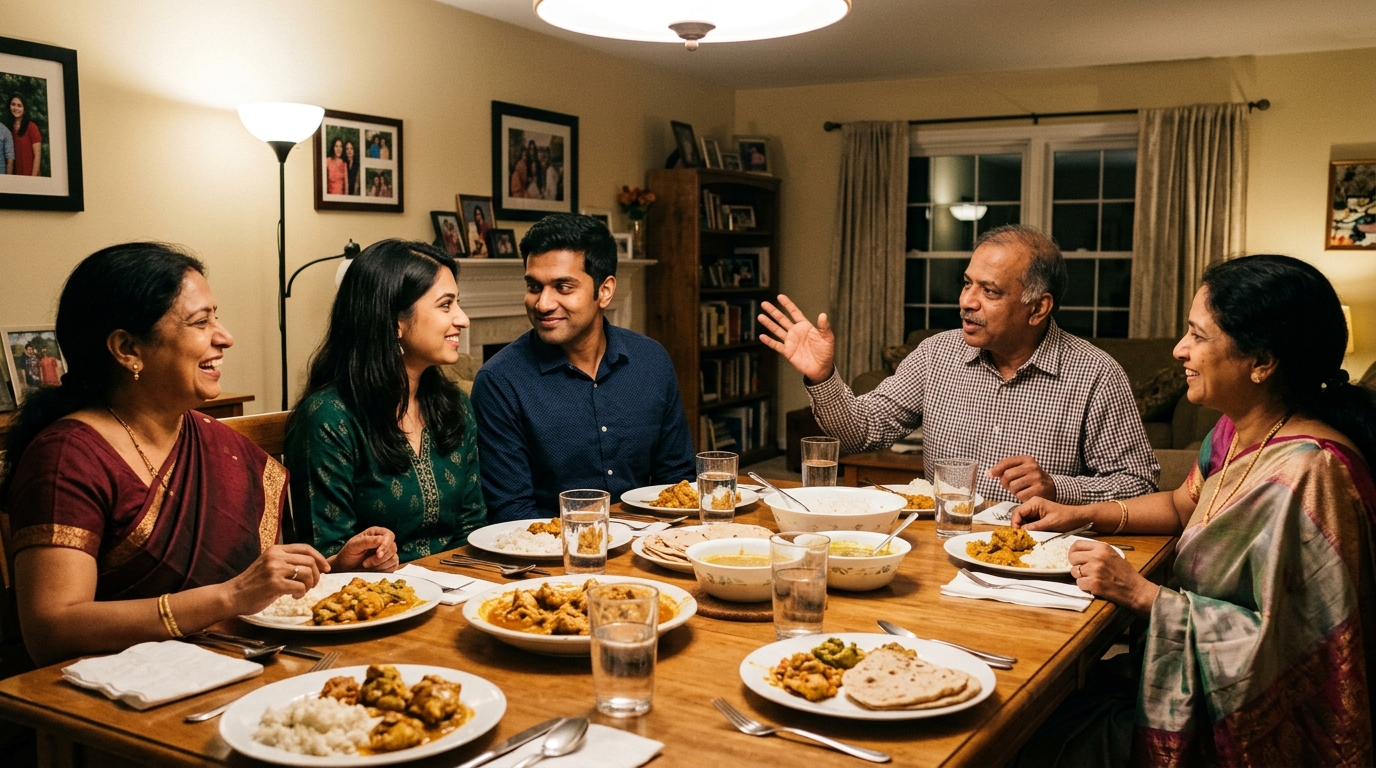
Here is an illustrative pairing of the type I see often. Priya is an Aries (fire, cardinal), and Dev is a Cancer (water, cardinal). Their kundlis scored 31, excellent by the usual bands. Both families were thrilled.
Then came the first dinner with both sets of parents. Dev's mother offered to host. Priya, who had pictured picking the restaurant herself, said they would book somewhere. Dev stepped in to smooth things for his mother, which Priya felt as being overruled in front of everyone. In the car, he said she'd been abrupt. She said he'd folded instantly.
The Western read explains it: both are cardinal signs, and cardinal signs initiate and want to lead. Aries leads by acting. Cancer leads by protecting the family and its feelings. Fire and water also differ in how they process a clash: Priya wants it resolved in the moment, while Dev withdraws and absorbs it. Those are general tendencies for the pairing, and plenty of Aries-Cancer couples do fine.
The kundli score was not wrong. It was answering a different question, about whether the match holds together over time and within the family. It never asked who books the restaurant. What this couple needs:
- Agree on who decides what before the next family event.
- Dev needs to say "I'm backing you" to Priya privately, before he steps in publicly.
- Priya needs to give Dev a day to reflect before expecting a resolution.
Getting a Western second opinion before the engagement
If your families are comfortable with kundli matching, a Western read doesn't have to replace it. Treat it as a check on daily temperament. Here is a sequence that works:
- Get your kundli breakdown by koota, not just the total. Note where points were lost.
- Write down both sun signs, with element and modality. Notice whether you share a modality, which predicts who pushes and who yields.
- Map the weak koota to a Western tension. A low Gana might line up with a fire-water or cardinal-cardinal clash. If both lenses flag the same friction, take it seriously.
- Pick one real scenario to test. Money, in-laws or a move across states. Talk it through before the engagement, not after.
- Ask about the unsettled bits. If Nadi or Manglik is in question, ask your pandit what remedies or exceptions apply.
- Run it by someone outside the family conversation. A friend who knows both of you will often spot what the charts only hint at.
When you're ready to see how your own pairing reads, get a Western-zodiac second opinion on your match for a breakdown across love, chemistry, marriage, communication and friendship. If you're curious about how your charts overlap in more detail, the explainer on synastry charts through the fights you're already having is a good next step.
Whichever method you lean on, the useful move is the same. Find the likely friction early, name it kindly, and decide together how you'll handle it.