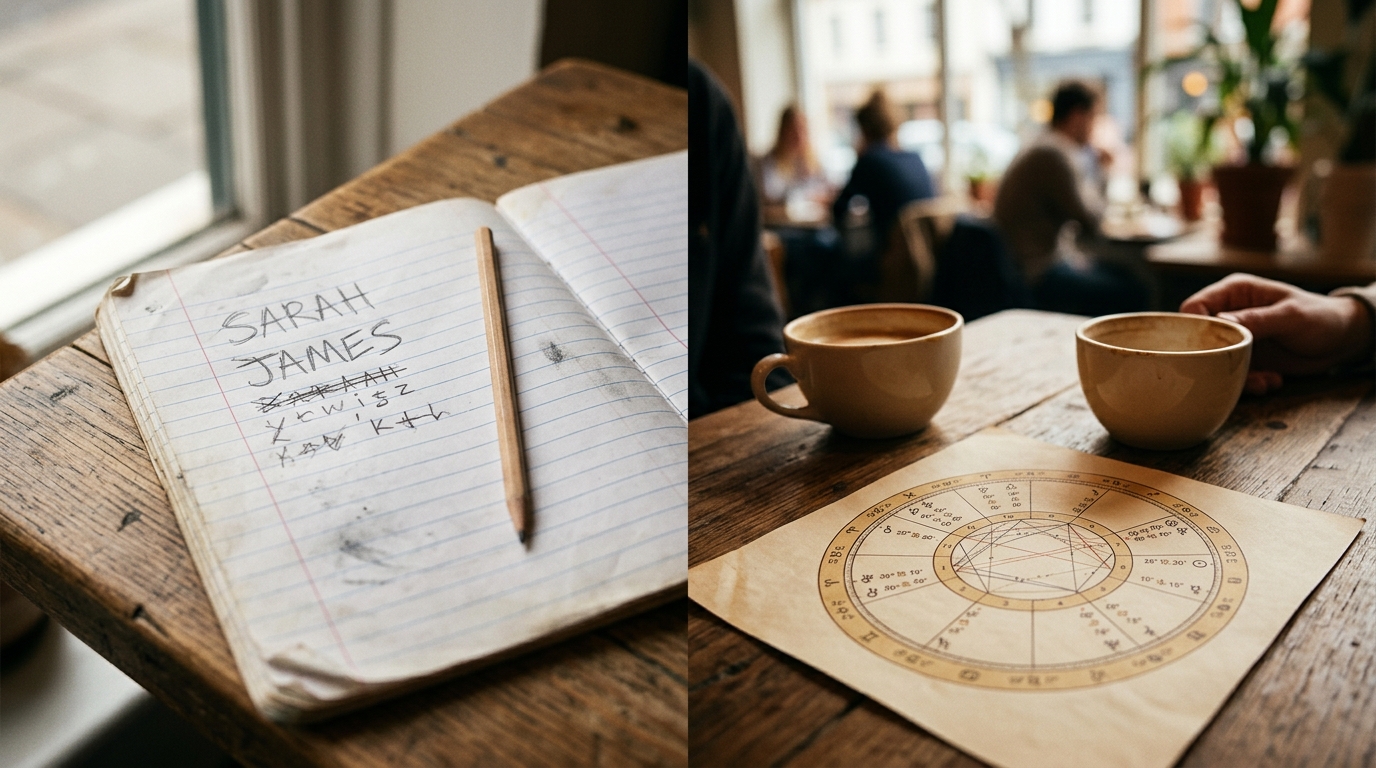
You and your crush, the back page of a maths notebook, a pen that's about to leak. Somebody wrote two names, somebody crossed out letters, and a single word decided the rest of the week.
If you want the rules without the Calgary hockey results, here they are. Then we'll break the game on purpose by adding one middle name, which is the most useful thing you can learn about it.
What does FLAMES stand for?
Each letter is a possible relationship outcome. These are the conventional meanings:
- F: Friends. Platonic, easy company.
- L: Love. Romantic interest, the one everybody hopes for.
- A: Affection. Fondness and warmth, a notch softer than Love. People argue about whether it's a consolation prize.
- M: Marriage. The jackpot, and the result that gets screenshotted.
- E: Enemies. Rivals, friction, the dreaded one.
- S: Sibling. Familiar, loyal, and deeply unromantic.
So if you were wondering what the A stands for in FLAMES, it's Affection. Regional versions swap a word here and there, but this is the standard set.
The FLAMES entry on Wikipedia) describes the game as one played to predict the future relationship between a person and their crush or celebrity crush. Keep that word "predict" in mind, because we'll deal with it shortly.
How to play FLAMES, step by step
Here's the full method. The example is two invented people, Priya and Rohan, passing a notebook back and forth at the back of a classroom.
- Write both names. PRIYA and ROHAN.
- Cross out shared letters, one for one. Priya and Rohan share R and A, so each pair of those goes. Left over: P, I, Y from Priya, and O, H, N from Rohan.
- Count what's left. Three plus three is 6.
- Write FLAMES in a row. Use that number as your count.
- Count and cross out. Start at F and count to 6. That lands on S, so Sibling is eliminated.
- Restart after the crossed-out letter. Count 6 again from the next remaining letter, wrapping around. The sequence goes F, then A, then L, then E, and the last one standing is M.
- Read the survivor. Priya and Rohan get Marriage, and the notebook gets passed back very quickly.
The GeeksforGeeks tutorial describes the same mechanism as a name-based entertainment game that works by removing common letters between two names. That's all it is: subtraction, then a loop.
Two house rules to settle before you play. Decide whether repeated letters cancel once per matching pair, which is the common way. And decide whether you use first names only or full names. That second choice matters more than people realise.
Try it with a middle name and watch it change
Same people, one change. Rohan writes his name as Rohan Dev.
- Write the names. PRIYA and ROHAN DEV (ROHANDEV, 8 letters).
- Cross out shared letters. R and A still match. Priya keeps P, I, Y. Rohan Dev keeps O, H, N, D, E, V.
- Count. Three plus six is 9.
- Run FLAMES with 9. Counting from F lands on A, so Affection goes. Restarting from M, the count lands on F. Then L goes. Then S. Then M.
- Survivor: E, Enemies.
Priya and Rohan went from Marriage to Enemies without a single thing changing about either of them. Same two people, same classroom, same crush. Only the number of letters on the page moved, from 6 to 9.
That is the whole argument against taking it seriously. A result that flips because someone adds a middle name, a nickname or an extra "h" in a spelling isn't measuring the relationship. It's measuring spelling. People already exploit this: if you don't like your result, you try another version of the name until the game agrees with you. The Wikipedia entry hints at the same habit, noting what happens when a player doesn't get the desired outcome.
Why name games feel right at 14
Is the FLAMES game real or fake? Plainly, it's fake as a predictor. It's letter-counting, with no astrological or scientific basis. Nothing about your names carries information about how you two get along. It's a game with a result, not a verdict.
So why did it feel so convincing? A few ordinary reasons:
- You wanted a particular answer. At 14 or 15, the stakes feel enormous and the evidence is thin. A ritual with a dramatic reveal fills that gap neatly.
- It's a safe way to say something. Writing two names on a page is a way to admit a crush without saying a word. If the result is Marriage, you share it. If it's Enemies, you blame the game.
- The reveal has real suspense. Crossing off letters one at a time builds tension, even though the outcome is fixed from the moment you count.
- You remember the hits. The time it said Love and the two of you did go out gets remembered. The seven times it said Sibling for a crush that went nowhere do not.
None of that makes it worthless. It's a good icebreaker and a harmless piece of nostalgia, and it works at a party or a group chat. Treat it that way, and it's fun.
Want something you can screenshot that's actually about you two?
If you ran your names and got Enemies, relax. If you got Marriage, also relax. Neither tells you anything about the person you're texting.
If you want an answer with reasoning behind it, the difference is what goes in. FLAMES counts letters, and letters shift with a spelling, a nickname or a middle name. A birth-date reading starts from something fixed: when each of you was born, which gives each person a sun sign, an element (fire, earth, air or water) and a modality (cardinal, fixed or mutable). The pairing is then read on those terms, so you can check the logic against your own relationship instead of trusting a crossed-out letter. Astrology is interpretive, and different traditions weigh things differently, but at least the inputs don't change when you rewrite a name.
It also doesn't collapse into a single word. Real relationships work differently across areas of life, and a pair can be strong in friendship and communication but need work in the bedroom or on marriage questions. One FLAMES letter can't say that. If you'd like to see how the methods differ, our piece on why a single compatibility score is the least interesting part walks through it. For another input that doesn't depend on spelling, there's life path numbers.
If you're curious about your own pairing, swap the name game for a real birth-date reading and see your breakdown across love, chemistry, marriage, communication and friendship. Keep FLAMES for the notebook page, where it belongs.